Case Report 5 – SynergEyes Multifocal & Progressive
SynergEyes Multifocal & Progressive Hybrid Contact Lenses
- 62yo Male
- OD: -4.00 / -1.25 x 123 (6/12)
- OS: -3.25 / -0.50 x 4 (6/6) ADD +2.00
- 62yo Male
- OD: -4.00 / -1.25 x 123 :: 7.94/8.11 (41.6D)
- 8.1/14.5/-4.50 Medium skirt ADD +1.75 (6/9)
- OS: -3.25 / -0.50 x 4 :: 7.78/8.03 (42.1D)
- 8.1/14.5/-3.50 Medium skirt ADD +1.75 (6/6=)
- OU: 6/6- and n5 (functional VDU vision!)
For information on the SynergEyes family of contact lenses and insertion and removal have a look here:SynergEyes Contact Lenses @ Mark Hinds Optometrists
Case Report 5 – Presbyopia, Astigmatism and SynergEyes Hybrid Multifocal Contact Lenses
Clinical Presentation
62-year-old male with established presbyopia and myopic astigmatism.
Spectacle Refraction
OD: −4.00 / −1.25 × 123 — VA 6/12
OS: −3.25 / −0.50 × 4 — VA 6/6
Near ADD: +2.00 D
At first glance, this appears to be a straightforward presbyopic contact lens fitting.
It is not.
There are several useful clinical questions hidden in this case:
- Why does the right eye only achieve 6/12 in spectacles?
- How much of the refractive astigmatism is corneal?
- Why choose a hybrid multifocal rather than a soft multifocal?
- Why is the contact lens ADD +1.75 when the spectacle ADD is +2.00?
- Why is binocular performance more important than chasing perfect monocular acuity at every distance?
- What does “functional VDU vision” actually mean in 2026?
What Is a Hybrid Contact Lens?
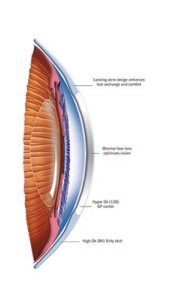
Figure 1. Cross-sectional illustration of the SynergEyes hybrid concept: a rigid gas-permeable central optic surrounded by a soft skirt.
A hybrid lens combines:
a rigid gas-permeable central optical zone
with
a surrounding soft contact lens skirt.
The rigid centre provides the optical characteristics of a corneal GP lens, while the soft skirt assists:
- centration;
- lens stability;
- comfort;
- retention; and
- overall wearability.
For a presbyopic patient with corneal astigmatism, this can be particularly useful.
The rigid central optic creates a post-lens tear layer, substantially neutralising anterior corneal astigmatism.
This differs fundamentally from a toric soft multifocal lens, where the cylindrical correction must remain aligned on the eye and is therefore dependent on rotational stability.
Corneal Curvature – A Useful Calculation
The historical keratometry was:
Right Eye
7.94 / 8.11 mm
Using:
K = 337.5 / radius in mm
this corresponds approximately to:
42.51 D / 41.62 D
giving approximately:
0.89 D of corneal toricity
Left Eye
7.78 / 8.03 mm
corresponding approximately to:
43.38 D / 42.03 D
giving approximately:
1.35 D of corneal toricity
This immediately gives the student something important to think about.
The spectacle cylinder is:
OD −1.25 D
OS −0.50 D
but the keratometric toricity is approximately:
OD 0.9 D
OS 1.35 D
Teaching Point
Refractive astigmatism is not synonymous with anterior corneal astigmatism.
The final subjective cylinder represents the combined optical effect of:
- anterior cornea;
- posterior cornea;
- crystalline lens/internal optics; and
- interactions between their magnitude and axes.
Without the keratometric axes we cannot perform a meaningful vector comparison in this historical case, but the values demonstrate why refractive cylinder should never simply be assumed to equal corneal cylinder.
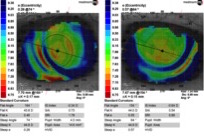
Corneal Topography
Figure 2. Original corneal topography from the case. Contemporary assessment would examine corneal shape, regularity, magnitude and axis of astigmatism rather than simply relying on central keratometry.
In 2026, corneal topography provides considerably more useful information than simply quoting two K readings.
Before selecting a GP-centred or hybrid optical system I would assess:
- magnitude of corneal astigmatism;
- regularity of the astigmatism;
- corneal symmetry;
- eccentricity;
- location of the visual axis relative to the corneal apex;
- lens centration potential; and
- any evidence of ectatic or other irregular corneal disease.
This matters because the rigid centre of a hybrid lens is particularly useful when a meaningful component of the refractive problem originates from the anterior corneal surface.
The Historical SynergEyes Fit
Right Eye
Spectacle Rx:
−4.00 / −1.25 × 123 — 6/12
Keratometry:
7.94 / 8.11 mm — approximately 41.6–42.5 D
Historical SynergEyes Multifocal:
8.1 / 14.5 / −4.50 / Medium skirt / ADD +1.75
VA: 6/9
Left Eye
Spectacle Rx:
−3.25 / −0.50 × 4 — 6/6
Keratometry:
7.78 / 8.03 mm — approximately 42.0–43.4 D
Historical SynergEyes Multifocal:
8.1 / 14.5 / −3.50 / Medium skirt / ADD +1.75
VA: 6/6=
Binocular Outcome
OU distance: 6/6−
Near: N5
The historical note described this as:
“Functional VDU vision.”
That remains an excellent clinical endpoint — but in 2026 we should define it considerably better.
Why Does the Right Eye Improve From 6/12 to 6/9?
This is clinically interesting.
A rigid optical surface can improve vision when part of the reduction in spectacle acuity originates from irregularity of the anterior corneal optics.
However, we cannot conclude from this historical information alone that corneal irregularity was responsible for the 6/12 spectacle acuity.
In a 62-year-old, unexplained monocular reduction in BCVA should be investigated.
A contemporary examination would consider:
- ocular surface quality;
- cataract or lenticular optical degradation;
- macular pathology;
- epiretinal membrane;
- amblyopia;
- corneal irregularity;
- higher-order aberration;
- optic nerve disease; and
- other retinal pathology.
Teaching Point
If one eye is 6/12 and the fellow eye is 6/6, do not simply write:
“That is his best eye.”
Ask:
Why is it 6/12?
At 62 years of age, I would expect contemporary assessment to include dilated examination and OCT macula if the cause was not already established.
The improvement to 6/9 with the hybrid lens suggests an optical component may have been present, but the remaining acuity limitation still requires explanation.
Why Doesn’t the Contact Lens Power Match the Spectacle Prescription?
This is another useful fourth-year calculation.
With moderate myopia, spectacle power should be adjusted for vertex distance when transferred to the corneal plane.
For example, a spectacle power around −4.00 D would ordinarily become slightly less minus at the corneal plane.
Yet the historical right contact lens was:
−4.50 D
Why?
Because a hybrid lens cannot be prescribed simply by vertexing the spectacle sphere.
The final power is influenced by:
- vertex distance;
- posterior lens curvature;
- corneal curvature;
- the induced tear-lens power;
- multifocal optical design;
- residual astigmatism; and
- the final over-refraction.
GP Principle
The rigid centre creates an optical tear lens.
Therefore:
Spectacle Rx ≠ final hybrid lens power
The final prescription must be based on the fitting relationship and over-refraction, not mathematical spectacle conversion alone.
Why Is the Spectacle ADD +2.00 but the Contact Lens ADD +1.75?
This is a particularly important presbyopia teaching point.
A spectacle ADD and a multifocal contact lens ADD are not directly interchangeable numbers.
The spectacle ADD represents the plus power required through a defined near portion of a spectacle lens.
A simultaneous-vision multifocal contact lens distributes multiple optical powers across the pupil.
Its performance is affected by:
- optical-zone architecture;
- centre-near versus centre-distance design;
- pupil diameter;
- lens centration;
- spherical aberration;
- ocular aberrations;
- illumination;
- working distance;
- neural adaptation; and
- binocular interaction.
The goal therefore is not:
“The patient needs +2.00 in spectacles, so the contact lens must have +2.00 ADD.”
The goal is:
“What is the lowest ADD that gives acceptable near and intermediate performance without unnecessarily degrading distance vision?”
In this case:
Spectacle ADD = +2.00 D
but
Hybrid multifocal ADD = +1.75 D
produced N5 binocularly with 6/6− distance vision.
That is a very good clinical result.
Multifocal Does Not Mean Three Separate Perfect Images
Modern multifocal contact lenses commonly use simultaneous-vision optics.
Different portions of the optical zone contribute light from different vergences at the same time.
The retina therefore receives a combination of relatively focused and defocused information.
The visual system must select and process the most useful information for the viewing distance.
This explains why multifocal contact lens fitting is a compromise between:
- distance resolution;
- intermediate vision;
- near vision;
- contrast;
- dysphotopsia;
- pupil size; and
- patient expectations.
A systematic review of presbyopia-correcting contact lenses found good evidence supporting their clinical efficacy, but also highlighted differences between designs and limitations within the published evidence base. [1]
Simultaneous Vision Versus Translating Bifocal Optics
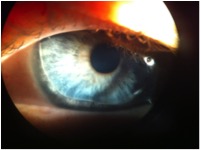
This historical page included images of older GP bifocal strategies, which provide an excellent opportunity to teach the difference.
Translating / Alternating GP Bifocals
Figure 3. Historical truncated translating GP bifocal design.
A translating or alternating GP bifocal works more like a bifocal spectacle lens.
The lens contains physically separated optical zones.
In primary gaze, the pupil looks predominantly through the distance zone.
On downgaze:
- the lower lid engages the lens;
- the eye rotates down behind it;
- the lens translates superiorly relative to the pupil; and
- the near optical segment moves into the visual axis.
Design features can include:
- prism ballast;
- truncation;
- segment height;
- lid attachment; and
- deliberate vertical translation.
This can provide excellent optical separation between distance and near.
The disadvantage is that successful performance is highly dependent upon lid anatomy and lens translation.
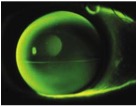
Fluorescein Appearance of a Translating GP Bifocal
Figure 4. Historical fluorescein image demonstrating a translating GP bifocal design.
This is fundamentally different from a simultaneous progressive multifocal.
A translating lens attempts to position the appropriate discrete optical zone in front of the pupil.
A simultaneous multifocal instead places more than one refractive power within the entrance pupil at the same time.
Both can work extremely well.
They solve presbyopia using different optical strategies.
Why Choose a Hybrid Multifocal?
This patient has several characteristics that make a hybrid multifocal an interesting option:
- moderate myopia;
- refractive astigmatism;
- measurable corneal toricity;
- established presbyopia;
- demand for useful distance, intermediate and near vision.
The rigid centre provides stable optics and neutralises much of the anterior corneal astigmatism.
The soft skirt helps provide the centration and comfort characteristics expected from a hybrid design.
A prospective comparative study specifically examining Duette Multifocal against two silicone-hydrogel soft multifocals found similar distance and near VA and similar binocular defocus-curve performance. Some monocular contrast-sensitivity and aberrometric outcomes favoured the hybrid lens, although the study was small and the authors appropriately called for larger studies. [2]
That is how this evidence should be presented to postgraduate students:
Interesting and supportive — but not definitive.
2026 SynergEyes Update
The exact lens parameters on this page are historical.
They should not be treated as a current fitting guide.
The contemporary SynergEyes presbyopic hybrid portfolio includes Duette Multifocal and Duette Progressive, together with newer individually designed multifocal/EDOF technology within the SynergEyes family.
The current Duette platform continues to combine:
GP central optics + silicone-hydrogel skirt
but contemporary designs and empirical fitting systems have evolved from the lens shown in this original case.
Importantly, current manufacturer information distinguishes the two Duette presbyopic approaches.
Duette Multifocal
Uses a progressive aspheric, centre-near multifocal optical concept.
Duette Progressive
Provides contemporary centre-distance and centre-near strategies to address different stages and visual demands of presbyopia.
For teaching purposes, the important lesson is not memorising a 2026 proprietary lens parameter.
It is understanding:
how the optical design interacts with the patient’s cornea, pupil and visual requirements.
Why Binocular Vision Matters
Monocular acuity in the fitted lenses was:
OD 6/9
OS 6/6=
Yet binocularly the patient achieved:
OU 6/6−
with
N5 near vision.
This is not a failure of the right lens.
It is an example of why presbyopia correction should be assessed binocularly.
Most real-world visual tasks occur with both eyes open.
The brain integrates information from the two eyes, and different optical compromises can coexist successfully when binocular performance remains strong.
Multifocal contact lens research increasingly includes:
- binocular defocus curves;
- reading performance;
- contrast sensitivity;
- functional tasks;
- patient-reported visual quality; and
- visual performance at multiple working distances.
Research comparing multifocal contact lenses with progressive spectacle lenses has found broadly comparable performance across several functional visual tasks, with subjects in that study expressing an overall preference for multifocal contact lenses. [3]
“Functional VDU Vision” – Update the Terminology
The original case quite reasonably celebrated:
6/6− and N5 — functional VDU vision.
In 2026 I would go further.
VDU – visual display unit is now largely historical terminology.
Most patients need vision across a continuous digital workspace:
Distance
Approximately 4–6 m and beyond
Intermediate
Approximately 60–100 cm
Desktop screens, dashboards, occupational displays and interpersonal distance.
Near
Approximately 35–50 cm
Phones, tablets, printed material and close work.
For a 62-year-old presbyope, measuring only:
6 m VA + N5 at 40 cm
can completely miss an intermediate failure.
Contemporary Clinical Endpoint
Measure:
- binocular distance VA;
- binocular intermediate VA at the patient’s actual working distance;
- binocular near VA;
- reading speed where relevant;
- low-contrast performance;
- glare/night vision where relevant;
- subjective visual quality; and
- sustained comfort.
A 2023 study demonstrated that multifocal contact lens correction can improve silent reading speed and fixation behaviour compared with distance single-vision correction, reinforcing that functional outcomes can reveal information that a single near-acuity measurement cannot. [4]
Presbyopia Is a Binocular Optimisation Problem
One of the mistakes students commonly make is trying to make:
OD perfect at distance + near
and then
OS perfect at distance + near.
That is not always how successful multifocal fitting works.
The clinical objective is often:
the best binocular visual system rather than two independently perfect monocular optical systems.
If increasing the ADD in one or both eyes gives one extra line of near vision but produces:
- ghosting;
- degraded distance contrast;
- poor night driving;
- unstable intermediate vision; or
- general dissatisfaction,
then the additional near acuity has not improved the patient’s visual system.
Modern presbyopia-correcting contact-lens trials therefore increasingly evaluate distance, intermediate and near vision together rather than simply reporting a near chart endpoint. Contemporary 2026 clinical trial data demonstrate that modern multifocal soft designs can provide high levels of binocular acuity across all three distances, reinforcing the importance of a range-of-vision endpoint. [5]
What Would I Measure if This Patient Presented in 2026?
1. Establish the Cause of the 6/12 OD
Before optimising contact lenses.
Assess:
- refraction and pinhole;
- ocular surface;
- corneal topography;
- crystalline lens;
- macula/OCT;
- optic nerve; and
- retinal health.
2. Document Corneal Optics
Obtain:
- keratometry;
- corneal topography;
- magnitude and axis of corneal astigmatism;
- corneal regularity; and
- elevation/tomography if indicated.
3. Assess the Ocular Surface
At 62 years of age, ocular-surface status becomes increasingly important to sustained contact-lens success.
Assess:
- symptoms;
- tear-film stability;
- meibomian gland function;
- staining;
- lid disease;
- conjunctival response; and
- lens-surface wettability.
Do not assume that poor multifocal vision is always an optical-design problem.
An unstable tear film creates an unstable first refracting surface.
4. Determine Ocular Dominance
Dominance can help guide asymmetric multifocal optimisation if required.
However, dominance should be used as a clinical tool rather than an absolute rule.
5. Measure Pupil Size
Measure under relevant:
- photopic;
- mesopic; and
- near-task conditions.
Pupil size alters the proportion of different power zones entering the eye in many simultaneous-vision designs and interacts with ocular aberrations and lens centration. [6,7]
6. Assess the Lens on Eye
For a hybrid lens evaluate:
- centration;
- movement;
- skirt alignment;
- corneal relationship;
- conjunctival response;
- lens surface;
- comfort; and
- over-refraction.
7. Measure the Whole Range of Vision
Not just 6 m and N5.
Test the patient at their actual:
- driving distance;
- computer distance;
- laptop distance;
- tablet distance;
- phone distance; and
- occupational working distance.
Clinical Take-Home Points
- Presbyopia fitting is not simply “distance Rx + spectacle ADD”.
- A hybrid lens combines rigid GP optics with a soft skirt.
- The rigid centre can neutralise anterior corneal astigmatism through the tear lens.
- Refractive cylinder does not equal corneal cylinder.
- The nominal multifocal ADD does not need to equal the spectacle ADD.
- Use the lowest ADD that provides satisfactory functional near and intermediate vision while preserving distance quality.
- Translating GP bifocals and simultaneous multifocals solve presbyopia differently. Translation physically changes the optical zone in front of the pupil; simultaneous multifocals present multiple vergences concurrently.
- Do not judge a presbyopic fitting monocularly. The final endpoint is usually binocular.
- 6/6 distance + N5 near does not guarantee good computer vision. Measure intermediate vision at the patient’s actual working distance.
- Unexplained 6/12 acuity in one eye of a 62-year-old deserves investigation.
- Visual acuity is only one outcome. Contrast, reading speed, night vision, stability, comfort and subjective quality matter.
- Historical lens parameters are useful for understanding optics — not as a 2026 fitting guide.
Peer-Reviewed Reading – QUT Master of Optometry
1. Molina-Martín A, Piñero DP, Martínez-Plaza E, Rodríguez-Vallejo M, Fernández J. Efficacy of Presbyopia-Correcting Contact Lenses: A Systematic Review. Eye Contact Lens. 2023;49(8):319–328. doi:10.1097/ICL.0000000000001013. PMID: 37418305.
2. Piñero DP, Carracedo G, Ruiz-Fortes P, Pérez-Cambrodí RJ. Comparative analysis of the visual performance and aberrometric outcomes with a new hybrid and two silicone hydrogel multifocal contact lenses: a pilot study. Clin Exp Optom. 2015;98(5):451–458. doi:10.1111/cxo.12299. PMID: 26390908.
3. Fogt JS, Weisenberger K, Fogt N. Visual performance with multifocal contact lenses and progressive addition spectacles. Cont Lens Anterior Eye. 2022;45(4):101472. doi:10.1016/j.clae.2021.101472. PMID: 34049808.
4. Plainis S, Ktistakis E, Tsilimbaris MK. Presbyopia correction with multifocal contact lenses: Evaluation of silent reading performance using eye movements analysis. Cont Lens Anterior Eye. 2023;46(4):101853. doi:10.1016/j.clae.2023.101853. PMID: 37164776.
5. Bickle K, Montaquila S, Giedd B, Wesley G, Perry M, Subramanian V. Comparison of Clinical Performance and Fit Success of Lehfilcon A and Lotrafilcon B Daily Wear Monthly Replacement Silicone Hydrogel Multifocal Contact Lenses in Patients with Presbyopia. Clin Optom (Auckl). 2026;18:542963. doi:10.2147/OPTO.S542963. PMID: 41868608.
6. Pérez-Prados R, Piñero DP, Pérez-Cambrodí RJ, Madrid-Costa D. Soft multifocal simultaneous image contact lenses: a review. Clin Exp Optom. 2017;100(2):107–127. doi:10.1111/cxo.12488. PMID: 27800638.
7. Fedtke C, Sha J, Thomas V, Ehrmann K, Bakaraju RC. Impact of spherical aberration terms on multifocal contact lens performance. Optom Vis Sci. 2017;94(2):197–207. doi:10.1097/OPX.0000000000001017. PMID: 27879499.
8. Abou Samra WA, El-Emam DS, Kasem MA. Clinical Performance of a Spherical Hybrid Lens Design in High Regular Astigmatism. Eye Contact Lens. 2018;44(Suppl 1)–S70. doi:10.1097/ICL.0000000000000326. PMID: 27660920.
9. Remón L, Pérez-Merino P, Macedo-de-Araújo RJ, Amorim-de-Sousa A, González-Méijome JM. Bifocal and Multifocal Contact Lenses for Presbyopia and Myopia Control. J Ophthalmol. 2020. PMID: 32318285.
Suggested Discussion Questions for Students
Question 1
The spectacle ADD is +2.00, yet the successful multifocal contact lens ADD is +1.75.
Why is matching the spectacle ADD not necessarily the correct approach when fitting a simultaneous-vision multifocal contact lens?
Question 2
The right eye improves from 6/12 in spectacles to 6/9 through the hybrid lens.
What possible mechanisms could explain this improvement, and what investigations would you undertake before attributing the difference to the contact lens?
Question 3
This patient achieved 6/6− binocular distance acuity and N5 near acuity.
What additional measurement is essential before concluding that he has satisfactory vision for modern computer and digital-device use?
Question 4
Explain the optical difference between:
a translating GP bifocal
and
a simultaneous progressive multifocal contact lens.
Question 5
The left eye has approximately 1.35 D of keratometric toricity but only −0.50 D of refractive cylinder.
What does this tell you about the relationship between anterior corneal and total ocular astigmatism?