Rinsada at Mark Hinds Optometrists
Do your eyes still feel gritty, irritated or inflamed despite using artificial tears and other dry-eye treatments? Do they feel as though something is trapped beneath your eyelids, or does your comfort improve temporarily after rinsing or using lubricating drops?
Sometimes treating the eyelid margins and adding more eye drops is not enough.
Inflammatory material, allergens, environmental particles and other irritants can remain across the ocular surface and particularly within the areas underneath the eyelids that conventional eye drops and routine eye rinsing may not effectively reach.
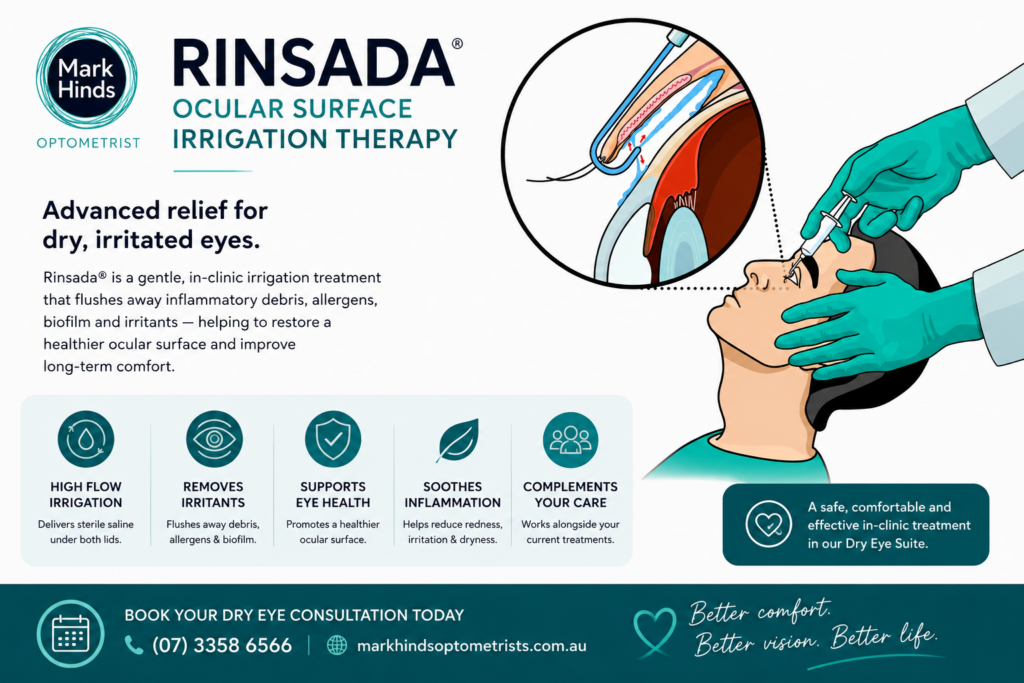
Rinsada is an in-clinic ocular surface irrigation treatment designed to thoroughly rinse the eye—including beneath the upper and lower eyelids and into the conjunctival fornices.
At Mark Hinds Optometrists in Brisbane, Rinsada may form part of an individualised treatment program for patients with dry eye disease, ocular surface irritation and inflammation.
What is Rinsada?
Rinsada is a sterile, single-use irrigating eyelid retractor used by trained eye-care practitioners.
The device gently retracts the eyelid while directing irrigation fluid across several important areas simultaneously:
- the bulbar conjunctiva covering the visible white part of the eye;
- the palpebral conjunctiva lining the inside of the eyelids; and
- the conjunctival fornix, the deeper recess where the eyelid folds back onto the eye.
These areas can be difficult to irrigate effectively with conventional eye drops or a standard eye rinse.
The concept is somewhat similar to thoroughly flushing the nasal passages with a sinus rinse: rather than simply adding another drop to the surface, Rinsada provides a controlled and directed rinse of areas that are normally hidden beneath the eyelids.
Rinsada is indicated for the removal of irritants from the ocular surface and was specifically designed for use by eye-care professionals.

Why would we want to rinse underneath the eyelids?
The ocular surface is much larger than the cornea we see when looking in the mirror.
Every time you blink, the inner surface of your eyelids moves across the tear film. The palpebral conjunctiva and deeper conjunctival fornices are therefore an important part of the ocular-surface environment.
In patients with ocular surface disease, these areas may harbour:
- inflammatory material;
- environmental pollutants;
- microscopic particulate matter;
- allergens;
- cellular debris; and
- components of ocular-surface biofilm.
Simply placing an artificial tear onto the exposed eye does not necessarily provide the same mechanical irrigation to the deeper areas beneath the eyelids.
Rinsada was engineered to direct irrigation specifically towards the palpebral conjunctiva, bulbar conjunctiva and conjunctival fornix rather than relying on fluid simply flowing across the exposed eye.
Dry eye is an inflammatory disease
Dry eye disease is much more complicated than simply “not producing enough tears”.
For many patients, dry eye involves a cycle of tear-film instability, increased evaporation, ocular-surface stress and inflammation. Once established, this inflammatory environment can contribute to burning, grittiness, redness, watering and fluctuating vision.
One marker commonly associated with ocular-surface inflammation is matrix metalloproteinase-9, or MMP-9.
A prospective multicentre randomised study investigated whether irrigation using an irrigating eyelid retractor could alter ocular-surface MMP-9 compared with conventional eye irrigation.
The researchers found a significantly greater reduction in MMP-9 following device-assisted complete ocular irrigation compared with standard irrigation three hours after treatment. The study also reported improvement in dry-eye symptoms and suggested that the effect on MMP-9 may persist in some patients beyond the immediate treatment period.
This does not mean that Rinsada cures dry eye disease.
Instead, it provides another potential tool for reducing the burden of material present on an inflamed ocular surface and may complement the other treatments being used to address the underlying causes of dry eye.
Who may benefit from Rinsada?
Rinsada may be considered in appropriately selected patients experiencing:
- persistent dry or uncomfortable eyes;
- grittiness or foreign-body sensation;
- burning or stinging;
- recurrent ocular-surface irritation;
- environmental irritation;
- exposure to dust or particulate matter;
- ocular allergy or allergen exposure;
- fluctuating vision associated with an unstable tear film;
- chronic ocular-surface inflammation; or
- dry-eye symptoms that remain problematic despite conventional management.
Rinsada may also be used alongside other in-clinic treatments when both the external eyelid surface and the ocular surface underneath the eyelids require attention.
Not everyone with dry eye requires Rinsada.
Dry eye disease is multifactorial, and symptoms can result from meibomian gland dysfunction, aqueous tear deficiency, blepharitis, allergy, inflammation, medications, contact-lens wear, systemic disease, environmental exposure and several other factors.
A proper dry-eye assessment remains essential before recommending treatment.
What happens during a Rinsada treatment?
Before treatment, your optometrist will assess your eyes to determine whether ocular-surface irrigation is appropriate.
This may include examination of your:
- tear film;
- cornea;
- conjunctiva;
- upper and lower eyelids;
- meibomian glands;
- eyelid margins; and
- ocular-surface staining.
During Rinsada treatment, the specially designed irrigating retractor is carefully positioned beneath the eyelid.
Sterile irrigation solution is then delivered through the device, directing fluid towards the inner eyelid surface, conjunctival fornix and exposed ocular surface.
Both the upper and lower eyelid regions can be treated.
Although the treatment can look somewhat intimidating when you first see the device, our experience has been that patients are often surprised by how comfortable—and even refreshing—the irrigation feels.
The procedure is performed in the clinic and does not involve surgery, injections or incisions.
Does Rinsada replace my normal dry-eye treatment?
Usually, no.
Rinsada is best considered an adjunctive ocular-surface treatment rather than a replacement for your existing dry-eye management.
Depending on the cause of your condition, your ongoing treatment may still include:
- preservative-free lubricating eye drops;
- prescription anti-inflammatory therapy;
- warm compresses;
- treatment of meibomian gland dysfunction;
- eyelid hygiene;
- management of Demodex or blepharitis;
- intense pulsed light or other in-clinic dry-eye treatments;
- environmental modification; or
- specialty contact lenses.
A published case report involving a patient with difficult-to-manage dry eye demonstrated substantial symptomatic and corneal-staining improvement following complete ocular lavage while the patient’s other established dry-eye therapies were continued. The authors described irrigation as a potentially useful adjunct for refractory ocular-surface disease while also recognising that further research is required.
Rinsada versus ZEST: what is the difference?
Rinsada and ZEST treat different parts of the ocular-surface environment, and in selected patients they can complement each other.
ZEST primarily cleans the outside.
ZEST provides professional cleansing and debridement of the eyelids, eyelashes and lid margins. It can help remove accumulated biofilm, oils, dead skin cells, cosmetic residue, crusting and Demodex-associated debris.
Rinsada cleans underneath.
Rinsada irrigates the eye itself and reaches beneath the eyelids, including the palpebral conjunctiva and conjunctival fornices.
An easy way to think about the difference is:
ZEST = eyelids and lashes.
Rinsada = ocular surface and underneath the eyelids.
For some patients with complex dry-eye or eyelid disease, addressing both environments may form part of a more comprehensive ocular-surface treatment strategy.
Can Rinsada help with eye allergies?
Potentially.
Allergens such as pollen and environmental particles can interact with tissues on and underneath the eyelids and initiate an inflammatory response.
Because Rinsada provides mechanical irrigation of the palpebral conjunctiva and conjunctival fornices, it may help physically remove allergens and particulate material from areas that are difficult to reach with conventional rinsing.
Rinsada should not, however, be regarded as a substitute for appropriate diagnosis and treatment of allergic eye disease.
Persistent itching, redness, swelling or watering should be properly assessed to distinguish allergy from dry eye, blepharitis, infection and other ocular-surface conditions.
Is Rinsada safe?
Rinsada is designed as a sterile, single-use device for professional ocular irrigation.
As with any procedure involving the ocular surface, treatment should only be undertaken after assessment by an appropriately trained eye-care practitioner.
Temporary watering or mild irritation may occur following ocular-surface procedures.
Sudden significant pain, marked redness, light sensitivity, discharge or reduced vision should always be assessed promptly rather than assumed to represent routine dry eye.
Sometimes the ocular surface needs more than another eye drop
Modern dry-eye management increasingly recognises that chronic ocular-surface disease often requires more than simply increasing the frequency of artificial tears.
The eyelids, meibomian glands, tear film, cornea, conjunctiva and inflammatory environment all need to be considered.
Rinsada provides us with a different approach: mechanically irrigating the ocular surface and areas underneath the eyelids that conventional rinsing may not adequately reach.
At Mark Hinds Optometrists in Teneriffe, Brisbane, our Dry Eye Studio combines detailed ocular-surface assessment with treatments including Rinsada, ZEST, meibomian gland therapies and other contemporary dry-eye management options.
We do not recommend the same treatment for every dry-eye patient.
Instead, we examine the tear film, eyelids, meibomian glands and ocular surface before determining which combination of treatments is most appropriate.
If your eyes continue to feel dry, gritty, burning, watery or irritated despite using eye drops, book a comprehensive dry-eye assessment and ask our team whether Rinsada ocular surface irrigation may be suitable for you.
References and further reading
Mayer N, Kondapalli SSA, Venkateswaran N, Saeed HN. The efficacy of an irrigating eyelid retractor-facilitated ocular rinse on MMP-9 expression and dry eye disease. Published 2024.
Maiti A, et al. Recalcitrant Dry Eye Disease in a 31-Year-Old Female: Favorable Outcomes Following Complete Ocular Lavage Facilitated by an Irrigating Eyelid Retractor. Published 2025.
Rinsada — information for patients and eye-care professionals.
This information is general and does not replace an individual eye examination. Dry-eye treatment recommendations depend on the underlying cause, severity of ocular-surface disease and individual clinical findings